
Attention-Deficit/Hyperactivity Disorder (ADHD) has always been perceived as an intricate neurodevelopmental disorder but a recent brain imaging study of 2026 is changing the definition and treatment of the disorder. Whether you have ever questioned yourself as to what ADHD is, how it is diagnosed, or why the symptoms are so different in each individual, this new study will give you significant answers.
Throughout this blog, we discuss the 3 new types of ADHD, general symptoms of ADHD, and how this will affect the diagnosis of ADHD, ADHD medication and psychiatric services for individuals and families.
What is ADHD?
ADHD is a disorder that impacts attention, impulse control and executive functioning. It has the potential to affect children, teens, and adults and can frequently affect daily life, relationships, and productivity.
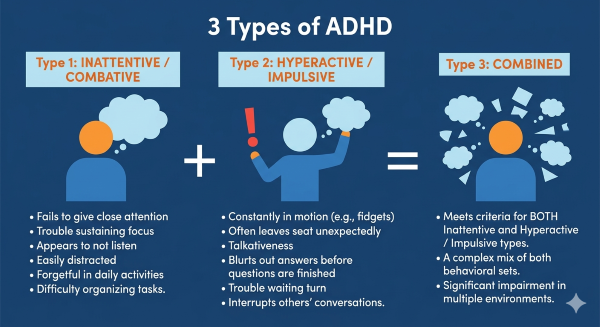
ADHD manifests itself in common symptoms such as the following:
- Problems with attention or organizing.
- Acting without thinking and impulsivity.
- Restlessness or hyperactivity
- Difficulty in doing things or in following directions.
- Loss of memory in day-to-day functions.
But how everyone has ADHD is not the same; this is where the new 2026 research comes in.
The 2026 Study: A New Way to Understand ADHD
Recent brain scan studies have revealed three different neurological patterns of people with ADHD. This study, instead of generalizing them into broad categories, highlights more particular distinctions in the brain-based differences and develops a better understanding of individual care.
1. Attention-Dominant ADHD (Cognitive Type)
The primary areas of impact of this type are focus, attention span and mental clarity.
Key characteristics:
- Easily distracted
- Difficulty sustaining attention
- Frequent daydreaming
- Slow information processing
Such kinds of people may not be regarded as hyperactive but there is an internal problem in terms of concentration and productivity. This usually results in underdiagnosis, particularly in adults.
2. Emotional Regulation ADHD (Affective Type)
The focus of this type is on emotional reactions and mood control.
Key characteristics:
- Intense emotional reactions
- Low frustration tolerance
- Mood swings
- Difficulty managing stress
This group stresses the fact that ADHD is not just an issue of attention; it is also an issue of emotional control. Psychiatric care of ADHD is sought by many people when they experience emotional symptoms overwhelmingly.
3. Impulsive-Hyperactive ADHD (Behavioral Type)
It is the most generally known form.
Key characteristics:
- Impulsivity.
- Interrupting conversations
- Acting without thinking
- Problem waiting/remaining still.
The type is usually diagnosed at a younger age since the symptoms are more apparent in the school or social environment.
Have questions? Ready to explore mental health services for you or a loved one?
Why This Matters for ADHD Diagnosis
Behavioral observations and checklists are commonly used as a basis of traditional ADHD diagnosis. This is a good approach but it does not necessarily give the whole picture.
The 2026 study presents a more brain-based concept, which implies the following:
- A more precise classification of the types of ADHD.
- Improved distinction of similar conditions.
- Increased individualization of care plans.
And, as you may have always wondered when you have been looking for psychiatry near me, this is a changing study that shows the need to work with professionals who are aware of the current knowledge of ADHD and treatment.
How This Affects ADHD Medication and Care
Not every type of ADHD is sensitive to ADHD medication. With this new classification, tailored approaches can be made more through Psychiatric Medication Management.
For example:
- Focus-enhancing drugs can be used to treat cognitive-type ADHD.
- Mood stabilization can be needed to address emotional-type ADHD.
- Impulse-control support might be effective with hyperactive-type ADHD.
Additionally, comprehensive care now includes:
- Frequent support psychiatric services and Care Coordination.
- Telehealth Care to obtain convenient and accessible care.
- Individualized observation to make changes in drugs and plans as time goes on.
The Role of Psychiatric Services in ADHD Care
Modern psychiatric services are not limited to diagnosis; they provide continuous support, which is personalized to your needs.
At Orlando Premier Psychiatry, the services are geared towards assisting people to:
- Know what type of ADHD they have.
- Get a correct and up-to-date diagnosis of ADHD.
- Access personalized Psychiatric Medication Management.
- Flexible care by Telehealth Services.
- Coordinated care with psychiatric services through care coordination.
The plan ensures that you not only change your symptoms but also improve your overall health.
What This Means for You
Regardless of your diagnosis or how many years you have had ADHD, this study gives you a great message:
ADHD is not one-size-fits-all.
Knowing your particular type can:
- Improve symptom management
- Enhance daily functioning
- Minimize frustration and misdiagnosis.
- Foster greater long-term results.
If you have experienced some issues with the symptoms or you feel that your current strategy of care is no longer effective, it might be time to rethink your approach to care and implement new findings.
Call Orlando Premier Psychiatry today for personalized ADHD support and care.

Take the Next Step Toward Clarity
Psychiatry near me might be exactly what you need, or perhaps you need a personal approach to ADHD, which can be achieved with professional help.
Orlando Premier Psychiatry is customized psychiatric care that provides personalized psychiatric services based on your needs to help you get a better understanding of ADHD and move on confidently.
Get expert psychiatric services and start your ADHD care journey today.
FAQs
1. What are the 3 types of ADHD in the 2026 study?
The research recognizes Cognitive (attention-focused), Affective (emotional regulation), and Behavioral (hyperactive-impulsive) types of ADHD.
2. What are common ADHD symptoms?
The typical symptoms of ADHD are inattention, impulsivity, restlessness, forgetfulness, and emotional difficulty.
3. How is ADHD diagnosis done?
Clinical assessment, history of symptoms and behavioral tests are used to diagnose ADHD, which is being complemented by new brain research.
4. Does ADHD medication work for everyone?
No, the effectiveness of ADHD medication differs with both the individual and type of ADHD. Individualized drug therapy is crucial.
5. Can adults have ADHD?
Yes, ADHD is a disorder that afflicts both the children and the adults. It is diagnosed in many adults later in life after they realize that they have some persistent symptoms.
Disclaimer
This blog is intended for educational and informational purposes only and should not be considered medical advice, diagnosis, or treatment. The 2026 ADHD biotype research is emerging scientific evidence and does not currently replace established diagnostic criteria outlined in the DSM-5-TR. ADHD diagnosis and treatment should always be conducted by qualified healthcare professionals.
References:
- American Psychiatric Association. Diagnostic and Statistical Manual of Mental Disorders, Fifth Edition, Text Revision (DSM-5-TR).
- National Institute of Mental Health (NIMH). Attention-Deficit/Hyperactivity Disorder (ADHD). Available at: https://www.nimh.nih.gov
- Centers for Disease Control and Prevention (CDC). ADHD Data and Statistics. Available at: https://www.cdc.gov/adhd