
A complete psychiatric examination performed by a trained mental health specialist, usually a psychiatrist is required to obtain an ADHD prescription, which also evaluates the patient’s medical history. The procedure includes:
- Clinical interviews
- Standardized assessment scales
- Excluding other diagnoses
- A physical exam for medication safety
The psychiatrist collaborates with you to decide on the best class of drug to take (a stimulant or non-stimulant) and devises a plan for taking medication that might involve regular monitoring, behavioral therapy and modification of the medication to effectively control symptoms of ADHD.
How to get ADHD Medication?
Just one positive step has been taken in understanding and managing the symptoms of ADHD. The next step of taking medicine for ADHD without a lot of stress is getting an evaluation if you have just been told that you have ADHD, or if you have had some suspicion, you should get an evaluation.
It is something we do at Orlando Premier Psychiatry on a daily basis and we know that the first thing we have to do is give the patient some valuable, factual information to learn if the patient is an adult who needs help.
Here you will find your symptoms explained alongside information on who can attend treatment as well as what is happening during the treatment, from evaluation to prescription.
Key Takeaways
- Mental health practitioners are the only ones who are allowed to prescribe medications used to treat ADHD. Typically involves a careful clinical history, examination of symptoms, administration of comprehensive standardized evaluation tools and a checklist of exclusion tests which will establish that the ADHD diagnosis is not a mistaken one, but instead a likely one that you have.
- Your physician (specifically a psychiatrist) is the best source for obtaining ADHD medicine for an adult because they can diagnose, prescribe and track progress of the treatment you are taking in one place.
- There is reliable testing that will diagnose ADHD and most states won’t allow for ADHD to be prescribed without a diagnosis. In simple presentations, perhaps the Primary Care Physician is able to easily diagnose problem(s) and prescribe treatment, while in the complex presentation, they may have a “referral” as their goal.
- There are two kinds of medication used to treat ADHD: Stimulants stimulate parts of the brain that help focus; Non-stimulants impact other pathways, i.e., the brain. These are based on the nature of symptoms and medical history, and your response to treatment.
Understanding ADHD Medication: The Basics
It is important to have an understanding of what ADHD medications do before trying to obtain medication. There are two classes of drugs approved by the FDA to treat symptoms of ADHD and enhance functioning: stimulants and non-stimulants. Despite the word ‘stimulant,’ these medications soothe the hyperactive brain of a person with ADHD. They do this by helping to upregulate dopamine, a chemical in the brain that plays a role in motivation, attention and movement.
Medicines that don’t contain stimulants work in different ways. Four non-stimulant drugs are FDA-approved:
- Strattera (atomoxetine)
- Intuniv (guanfacine)
- Kapvay (clonidine)
- Qelbree (viloxazine)
Although a few of these are typically used mainly by children and grown-ups with certain medical problems, like heart problems or who aren’t receptive to stimulants.
Medications for ADHD do not work to change styles or personalities but rather are used to minimize “extra” neurological symptoms that may make concentration, organization and controlling impulses harder when they are not distracted by extraneous information.
Medications generally are most effective when used in combination with other treatment components (behavioral strategies, healthy sleep, exercise and, perhaps, therapy).
Step One: Finding the Right Mental Health Professional
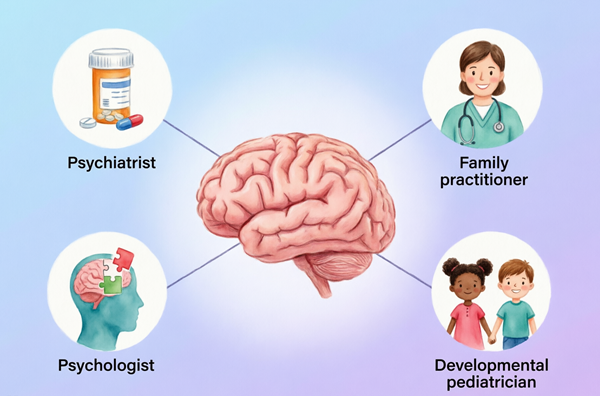
The first decision to make will be with respect to what kind of clinician you want to go to. All providers have their own strengths in assessing children and families and in working with them.
Provider Type | Can Diagnose ADHD? | Can Prescribe Medication? | Best For |
Psychiatrist | Yes | Yes | Full diagnosis + medication management in one place |
Psychologist | Yes | No (in most states) | Comprehensive neuropsychological evaluation |
Primary Care Provider | Yes (simpler cases) | Yes (simpler cases) | Initial assessment; may refer complex cases |
School Social Workers / Therapists | No | No | Child assessment and referral only |
Psychiatrist
The psychiatrists are healthcare providers that work with mental health disorders. In one practice, they can make a diagnosis, prescribe any medication required and monitor your treatment and progress! As an adult, if you are interested in medications for ADHD, then you should go to a psychiatrist as he or she is not mandated to be referred in order to prescribe medications for ADHD.
The first appointment for an ADHD assessment takes about 60-90 minutes by a psychiatrist, and the evaluation will include all of the mental conditions that might exist as well as your history of symptoms, your childhood behavior, your current functioning, and other psychiatric conditions.
Psychologist
There are psychologists to perform psychological tests and diagnoses as well in most States, the psychologist is not granted the means to prescribe medication for ADHD. If you are interested in having a comprehensive neuropsychological evaluation, then you should consider working with a clinical psychologist. The prescription, however, is to be gotten from a psychiatrist/physician.
Primary Care Provider
Having a primary care provider is your choice, but since you can’t imagine other health issues that you may have, you don’t really think of “ADHD,” it might be the best move to have a primary care provider. A number of primary care providers can diagnose ADHD and may be suitable to prescribe ADHD-related drugs.
If symptoms are more complex, they may also occur with other mental health issues like anxiety or depression, or you could be a drinker or a drug abuser, and your main health practitioner may recommend that you be referred to another specialist.
School Social Workers and Therapists
School social workers and therapists can complete an assessment of the child for ADHD and make appropriate referrals to another health care professional to initiate formal assessment and diagnosis of the condition, which cannot be diagnosed or prescribed.
A psychiatrist at Orlando Premier Psychiatry is a straightforward method for most adults requiring a dependable diagnosis and effective management of medication in order to get a great handle on the Orlando area.
Step Two: The Psychiatric Evaluation Process
Once an appointment is made, you’ll get a detailed, thorough analysis. There is no single test to diagnose ADHD: doctors use various methods and questioning techniques to establish a profile of their symptoms and history of the disorder.
At your first visit, your psychiatrist will have a series of questions and a structured clinical interview to review:
- New symptoms detailed questioning about attention, attention problems, impulse control (current and through life), organisation, time management, emotional regulation (current/lifetime)
- Childhood history – For the diagnosis of ADHD, the following parenthetical symptoms are listed in the DSM-5: ADHD symptoms were present before age 12 years. Your psychiatrist will discuss your childhood and if possible, your teen(s) will discuss your childhood and read your school records.
- Activity – what the symptoms of ADHD are currently changing about functioning (work, relationship, finances, life, etc.)
- Medical and psychiatric history – Has a past or present physical illness, whether or not the person takes medication for it, psychiatric history, drug abuse, alcoholism, past or current psychiatric or psychological issues in the household, including ADD/ADHD
He or she will also use pre-designed inventory tools such as the Adult ADHD Self-Report Scale (ASRS), Conners Rating Scale or other standard scores. It helps to objectively find out the severity of symptoms from these questionnaires and helps to create a diagnosis.
Your psychiatrist will go to great lengths to dismiss other conditions that mimic signs and symptoms of ADHD, such as:
- Anxiety disorders
- Depression
- Bipolar disorder
- Thyroid problems
- Disorders of sleep
- Substance use disorders
All these should be familiar to your doctor.
Physical examination is also advocated to assist in diagnosis. Heart rate, blood pressure and overall health will be evaluated by your psychiatrist, since stimulant medicines do impact the cardiovascular system and may not be suitable for all people. Students will come to understand the criteria for the steps to be taken to meet graduation.
Step Three: Meeting Qualification Criteria
So far as you are concerned, if you’re unsure that you qualify for the use of medication to treat ADHD, then it basically depends on whether you qualify to have a diagnosis of ADHD. There is a diagnostic manual, “DSM-5,” which has the following rules:
- Persistent pattern of inattention or hyperactivity/impulsivity and that causes impairment in functioning or development.
- There is a cluster of inattention and/or hyperactive/impulsive symptoms that has been present persistently for at least one month and before the age of 12.
- Symptoms have to be observed in other environments or in different settings, which include social environments, schools, work environments, and home environments. Evidence can be shown that symptoms are present and impair social, academic, and/or occupational functioning.
- The symptoms cannot be attributed to any other mental disorder, medical disorder or drug misuse.
Many adults experienced the same symptoms in their childhood as they do now but were not diagnosed, particularly women and those with symptoms that were not as disruptive in school. Your children don’t necessarily have to record the diagnosis; a thorough clinical interview of your entire lifelong symptom pattern will suffice.
Step Four: ADHD Medication Selection and Titration
Once your psychiatrist has determined you have ADHD and has agreed that you should take a medication, he or she will explain to you the options for medications you can use to treat your ADHD so you can make a decision on which medication will work best for you.
This does not necessarily exist as ‘best suit all.’ Your psychiatrist will take into account:
- Core symptoms: Inattention, hyperactivity-impulsivity, or both?
- Medical history: Any medication that may be risky given prior heart problems, high blood pressure, seizure or other medical issues
- Drug sensitivity: Any history of sensitivity to any drug
- Co-occurring conditions: Anxiety, depression, bipolar disorder — there are some drugs that you may be unable to take or which may not be the right choice if you have these conditions
- Lifestyle/routine: Some medications require a certain dosage pattern for them to be effective
If your physician prescribes you an ADHD medication, he or she will likely carefully titrate your medication to ensure your medication is taken in an optimal amount, which will have the most impact and keep the side effects from the medication to a minimum. This typically takes a couple of weeks. Do remind about reactions that may be occurring (if applicable) re dose adjustment, coping (repeated visits), treatments.
Continual supervision is essential. Medications and any side effects, along with your blood pressure and heart rate, will be used to check you to see how effective you are at this period, regularly. Most psychiatrists see patients in the first 2-4 weeks and then each month or every 3 months thereafter, once the person is stabilized on a dose.
Any reason not to start taking medication for your ADHD? At Orlando Premier Psychiatry, we focus on total care/support and offer full, comprehensive and holistic Assessment for ADHD as well as medication with care as well as continuous support for authentic symptom relief. Our psychiatrists are trained and know about adult ADHD and aim to provide the optimal treatment to best suit your needs.
Combining Medication with Other Treatment Approaches
You can get your child the most benefit if your child’s ADHD medications are used along with other effective and proven interventions. CBT for ADHD has a solid base in science and provides you with some practical tools to work on your organizational skills, time planning and coping skills related to what ADHD means for you, but you might not know what.
All of these numbers of behavioral interventions, along with the optimization of sleep, regular exercise and environment changes, are contributing to the total management of ADHD. Medication alleviates the neurological obstacles; therapy and lifestyle adjustments take care of the behavioral downfalls and emotional difficulties of ADHD that is undiagnosed or untreated.
Insurance and Cost Considerations
Coverage for evaluation and/or medicine will most likely be provided for your cost by your health insurance plan but coverage may be different depending on your type of health insurance plan. Services to be included or excluded and the types of services provided will be quite variable, particularly with regard to specialized evaluation for ADHD treatment. Be sure to check with your insurance accepted prior to booking an appointment so you are aware of what you will be responsible for.
When diagnosed with ADHD and if you go ahead and sign the prescription, you’ll be able to get a prescription to the medications for ADHD. Without insurance there will be no coverage for the evaluation and treatment and all costs will be paid out of pocket. A few of the psychiatry practices even collaborate with the patients with regard to payment plans and some charge on a sliding scale.
Why Untreated ADHD Matters
If not treated, ADHD may impact an individual in multiple ways. If ADHD is left untreated, it may lead to:
- Problems with the adult regarding work, money, and relationships with others and emotional problems
- More risks that a person takes in their lifetime when they don’t receive ADHD treatment (or other mental health disorder)
- Fewer mental health substance usage problems
- Emergency room visits related to having untreated ADHD
Then, the process of going off ADHD drugs and getting help is not life-changing; it’s merely the removal of those barriers buried within the brain, and living life with them gone. Once treated, you will be able to run at a normal pace, not with U.T. symptoms.
Moving Forward: Your Next Steps
Considering ADHD medications can be easier than you think. Services for adult ADHD assessment and medication management. No treatment is always different. Our psychiatrists will take the time to get to know you, the person you are and many of the things that have happened in your life.
If possible, please bring:
- Anything you know regarding the symptoms in the child and your life as a child and how that has affected you in your current life
- Any concerns or worries, history of health or history of any reaction to medicines
The more you tell your psychiatrist, the more he or she will be able to diagnose and treat your ADHD.
There is a possibility of recovery and symptom management. The diagnosis and care, along with the right treatment, are something you can live without those problems and the constant battle of an untreated ADHD and experience what it’s like not to have those things!
Conquer ADHD today. Call Orlando Premier Psychiatry today for an appointment to complete an ADHD evaluation and talk about the potential of combining an ADHD medicine and an ADHD therapy medication. You can trust our caring and skilled psychiatrists to help you stay on your path to improved concentration, organization and well-being.
Frequently Asked Questions
Is it hard to get prescribed ADHD meds?
No, getting prescribed ADHD medication isn’t inherently difficult if you have a genuine ADHD diagnosis. The process requires a proper psychiatric evaluation, but most psychiatrists are experienced in this assessment. Once diagnosed, psychiatrists routinely prescribe ADHD medication as a standard treatment. The challenge is often finding available appointments rather than meeting criteria.
How do you qualify for ADHD medication?
You qualify for ADHD medication by meeting DSM-5 diagnostic criteria: persistent inattention or hyperactivity-impulsivity symptoms that interfere with functioning, with evidence that symptoms were present before age 12, occur in multiple settings, and aren’t better explained by another condition. A psychiatrist conducts a comprehensive evaluation to confirm diagnosis.
What is the 1-3-5 rule for ADHD?
The 1-3-5 rule is a productivity strategy for ADHD: each day, identify one major task, three medium tasks, and five small tasks. This helps ADHD brains avoid overwhelm by creating realistic daily priorities and providing the structure many ADHD individuals need to stay focused and complete work efficiently.
What is the fastest way to get ADHD medication?
The fastest way to get ADHD medication is to see a psychiatrist who specializes in ADHD, as they can diagnose and prescribe within one practice without referrals. Some psychiatry practices offer online evaluations, which can accelerate the process. Being prepared with detailed symptom history and any childhood school records also speeds up accurate diagnosis and medication initiation.
What are the top 3 signs of ADHD?
The three most characteristic signs of ADHD are: persistent difficulty sustaining attention and completing tasks; impulsivity or difficulty controlling actions and speech; and hyperactivity or excessive restlessness. These symptoms manifest differently in different people and may appear as disorganization, time blindness, emotional dysregulation, or difficulty managing multiple priorities.
What is the 24-hour rule for ADHD?
The 24-hour rule is an impulse management strategy: before acting on an impulsive decision, a purchase, commitment, or reactive response, wait 24 hours. This pause allows the ADHD brain’s prefrontal cortex more opportunity to engage, producing clearer, less reactive decisions and helping prevent ADHD-related impulsive choices.
Disclaimer
This blog post is intended for general informational purposes only and does not constitute medical advice, diagnosis, or treatment. The content is not a substitute for professional medical guidance from a licensed mental health clinician, psychiatrist, physician, or other qualified healthcare provider.
References
- U.S. Food and Drug Administration (FDA). Treating and Dealing with ADHD.
- National Institute of Mental Health (NIMH). Attention-Deficit/Hyperactivity Disorder (ADHD).
- American Academy of Family Physicians (AAFP). Adult ADHD Toolkit for Family Physicians.