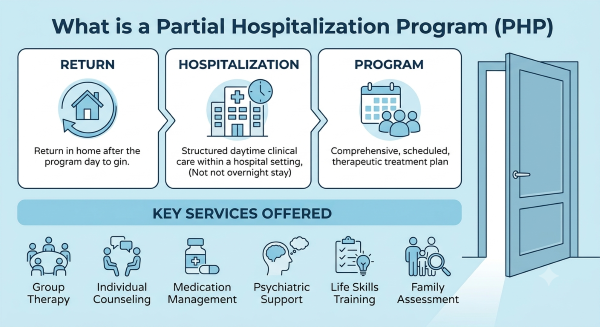
Partial hospitalization (PHP) programs are outpatient treatment facilities that are very intensive and include a variety of program levels that offer patients greater mental health treatment than would be a weekly outpatient session but not inpatient treatment.
- Treatment is administered over 4-8 hours per day, five days a week
- Consists of individual and group therapy, skills training, psychiatric medication management, and additional therapies
- Participants come back each evening to their homes, where they can do their work but also have a 24-hour support network, including family and other community services
- Offers a full menu of mental health services in a therapeutic atmosphere
If you are looking for mental health services but can’t make weekly therapy sessions work, and aren’t ready to commit to a hospital, adult partial hospitalization programs could be ideal for you. Orlando Premier Psychiatry receives numerous adults every day who fall somewhere between these extremes, needing intensive and strong care, but still feeling like they want to live in their own house, and go to their own work every day and participate in other activities.
If you need this type of treatment, you want to know what their care programs and services will be and how they work to choose the best adult partial hospitalization program that works for you.
Let’s discuss this treatment option, store and other levels of care and whether or not this treatment might be relevant to you.
Key Takeaways
- There is a mental health treatment continuum that includes partial hospitalization for adults, which is complexly balanced. They are intense enough to work on severe psychiatric problems and crises but not so intense that you are unable to go back home every night and be able to keep up your connections with your work, family and community.
- The average number of hours spent during a typical PHP is between 20 and 40 hours per week or in a 4- to 8-hour session per week, five days a week.
- The program is an excellent step-down from inpatient psychiatric hospitalizations and lets you get better gradually, not all at once and rejoin a life of independence.
- Studies have shown that the recovery results achieved in a PHP are similar or better than the recovery that can be attained in an inpatient program, and PHP patients are more satisfied and better reintegrated into their home communities.
What Exactly is a Partial Hospitalization Program?
The American Association for Partial Hospitalization (AAPH) defines a PHP as being an outpatient program that is specifically referred to diagnose and actively treat serious mental disorders while having a reasonable expectation that the patient will improve and/or wanting to keep a patient functioning and avoid hospitalization or re-hospitalization. It means that it is a whole-day psychiatric treatment-centered program; however, you don’t need to reside at the mental healthcare facility overnight while on treatment.
Consider it to be the link between hospitalization and outpatient care. You’re receiving treatment at the clinical level:
- Many sessions each day by licensed clinicians and psychiatrists on the treatment team
- Medication continuity
- A program setting that is structured for recovery
There doesn’t have to be anything wrong with bedding in a hospital! At the end of the day you will have your own bed and your own responsibilities at home and work; you will feel refreshed and it will be the next morning, an opportunity for more treatment.
This is what the difference is. Partial hospitalization, as opposed to an inpatient setting, takes you somewhat out of your “real” world but puts you right into your real life as you learn through treatment.
Take a day to process it with your boss, discuss it in a group, brainstorm ideas and then test them out right away the following day. This real-world integration will go towards accelerating the learning process and creating real, lasting changes.
How Adult Partial Hospitalization Programs Work
Step 1: Evaluation A thorough evaluation is a typical beginning of a PHP.
- A psychiatrist will review your treatment goals, medications, mental health history, symptoms of mental illness and medical condition
- A care coordinator will review your personal goals for treatment
- Together, you and they will create a personalized treatment plan based on that assessment
Step 2: Daily Structure During the program, there is generally a plan each day.
- A check-in group where people can talk about areas of their minds
- Individual therapy
- Group therapy around a shared problem for example, emotional regulation, communication and dealing with trauma
- Psychoeducational workshops covering topics like understanding diagnosis, managing medication, sleep hygiene, and healthy relationships
Step 3: Care Team A multidisciplinary team works with patients all day long, including:
- Psychiatrists
- Therapists
- A nurse
- A case manager
- An occupational therapist or recreation specialist
Medication management is also part of this: your medication is reviewed and adjusted on a regular basis based on your reactions and needs.
This is one thing that is missing from a single week of therapy and a PHP has one that can help to fill in that gap: a robust structure of support and continuity within a therapeutic community. It’s really healing to just be with people who understand you’re experiencing something similar to them.
Group therapy is not just an intervention, it’s a chance to witness what’s already in place in us, learn how to recognize the patterns we noticed in others, and practice new skills in a safe space.
When is PHP Appropriate?
PHP makes an excellent option in several situations:
- Stepping down from inpatient care: if you just left inpatient hospital treatment and require intensive support and a level of care going forward
- Stalled outpatient progress: if you are in outpatient therapy for weeks and months without gaining any ground, stalled or had a significant hiccup, it’s time to turn up the dosage of treatment and enter PHP
- Crisis with a safe home base: if you feel you have a safe home base and are having a crisis (for example, very depressed, anxious, manic or thoughts that are dangerous or overly overwhelming), but you are medically stable, PHP may be an appropriate option. The intensive care program will eliminate the intensity of symptoms but still not require you to be admitted to a care environment with doctors and nurses who have to be around you all day.
- Preventative care: adults with a history of psychiatric hospitalizations who are aware of early signs and symptoms of a psychiatric relapse can use earlier attendance of PHP to help avert the risk of needing future hospitalization
General stabilization: PHP is sufficient for psychiatric treatment of patients where neither suicide nor homicide poses an immediate threat and for those who only need to be stabilized through psychological and/or pharmacological treatment
PHP vs. Other Levels of Care
Level of Care | Intensity / Hours | Setting | Best For |
Inpatient Hospitalization | 24 hours medically monitored | Restricted environment, overnight stay | When you are in real danger to yourself or others |
Partial Hospitalization (PHP) | More than 20 hours a week of treatment during the day | Go home at night | Not life-threatening, but serious and extended assistance is required |
Intensive Outpatient Treatment (IOP) | 9 to 20 hours per week | A few evenings or afternoons | A normal routine is maintained but great clinical support is provided |
Typical Outpatient Therapy | 1 (sometimes 2) times per week | With a therapist or psychiatrist | Suitable for ongoing care, but may not be strong enough during crisis and severe symptomology |
What Conditions Does PHP Treat?
Partial hospitalization services for adults are designed to provide care for many different serious mental health disorders:
- Depression: very effective, especially for moderate to severe depression and suicidal ideation
- Anxiety disorders: excessive skill building and exposure may benefit severe cases where anxiety is causing significant impairment or interfering with daily activities
- Bipolar disorder: maintaining a normal lifestyle in PHP is most important because a normal-functioning life can effectively combat bipolar disorder during mood episodes or depression
- Psychotic disorders, trauma-resolution disorders, and personality disorders: the all-encompassing strategy is beneficial for this range of psychological disorders
- Co-occurring disorders: increasing numbers of PHP programs treat co-occurring disorders, where someone is suffering from a mental health and substance use disorder at the same time
Thinking about going to, or considering partial hospitalization? Your staff at Orlando Premier Psychiatry strives to address your case in a confidential and ethical way. We can work together to determine what care you will need to meet your needs during the admission process. It’s not required, just a dialogue with a physician with experience and real expertise about what you’re experiencing. Phone us today, or consult us to find out more!
Cost and Insurance Coverage
Probably one of the most common problems people will encounter with PHP is the cost.
- PHP is usually covered by insurance since it’s a medically necessary treatment
- Under the Affordable Care Act, mental health treatment is considered an essential health benefit, meaning most health plans must offer some insurance coverage for PHP
- Coverage varies by policy, some plans offer PHP with minimal or no copayment, others may have coinsurance
- Best practice: contact your insurance company or the PHP program directly to check your coverage before starting
- Many programs have staff dedicated to helping with insurance queries, removing confusion around the process
Cost Breakdown:
Program Type | Cost |
Daily rate (varies by program, location, services) | $100 – $400+ per day |
Long-term program | $9,000 – $18,000 per month |
Short-term intensive program | $6,000 – $12,000 total |
Inpatient hospitalization (for comparison) | $400 – $900 per day |
Many programs may also offer a sliding scale fee, payment plan, or scholarship if cost continues to be an issue even with insurance. The admissions team understands that finances can pose a challenge, so openly discussing your financial hardships with them can help ensure you get the treatment you need.

The Recovery-Based Approach
Some of the greatest advantages of the partial hospital treatment plan program are that it provides you with information about what you can anticipate at the end of treatment. Your health care providers are concerned not just with your current emergency; they are thinking ahead of what might happen next.
Making the Transition Back to Independence
As you progress through the program, you will begin to investigate what support you will need following discharge, and you will get help making connections to community services, such as:
- Follow-up outpatient consultations
- Referral to support group
- Work on re-establishing links to peer counsellors
- Work towards return to work
The objective is to help you finish the completion of the PHP without falling off a cliff and to make a transfer to a sustainable support system to keep you on track.
Wishing to explore further with regard to mental well-being? Orlando Premier Psychiatry’s partial hospitalization program is created with care and compassion. We’re here to provide as much intensive, individualized support as you could ever need, from inpatient treatment to outpatient treatment.
Consult us now and healing is possible, don’t have to do it on your own.
Frequently Asked Questions
What is the purpose of a partial hospitalization program?
PHPs provide intensive crisis stabilization and symptom management for adults who need more support than outpatient therapy but don’t require 24-hour inpatient care. They bridge the gap between hospitalization and independence, offering structured treatment while allowing patients to maintain employment, family connections, and home responsibilities.
How much does a PHP program cost?
PHP costs range from $100 to $400 per day, with short-term programs typically costing $6,000 to $12,000 and long-term programs $9,000 to $18,000 monthly. Most insurance plans cover PHP as a medical necessity. Uninsured patients can often access sliding scales, payment plans, or scholarships through the treatment facility.
Are PHP programs worth it?
Yes. Research shows PHP participants achieve comparable or superior outcomes to inpatient care with greater patient satisfaction and easier reintegration into daily life. The combination of intensive treatment and home-based living creates effective, lasting change while being significantly more cost-effective than inpatient hospitalization.
What is the partial hospitalization program in Massachusetts?
Massachusetts PHPs follow the same clinical model as other states — intensive outpatient mental health treatment combining individual therapy, group counseling, medication management, and skills training. Programs operate daytime hours, five days weekly, and are covered by most Massachusetts insurance plans including MassHealth.
At what point do I need to admit myself to a mental hospital?
Inpatient hospitalization becomes necessary when you’re actively suicidal with a plan, acutely homicidal, experiencing severe psychosis with inability to care for yourself, or in medical danger from withdrawal or severe psychiatric symptoms. If you’re having these thoughts, call 988 (Suicide & Crisis Lifeline) or go to your nearest emergency room immediately.
What is the 3-month rule in mental health?
The “3-month rule” isn’t a formal clinical standard. However, many therapeutic approaches suggest that meaningful change becomes measurable after approximately three months of consistent treatment participation. This timeline allows sufficient time for symptom stabilization, therapeutic relationship building, and integration of new coping skills.
Disclaimer
The information provided in this blog post is intended for general educational purposes only and does not constitute medical advice, diagnosis, or professional treatment recommendations. Every individual’s mental health situation is unique and requires personalized assessment by qualified mental health professionals.