If you’ve ever wondered what type of drug is ketamine, you’re not alone. Ketamine has gained much attention in recent years for its rising role in mental health care, especially when it comes to people who haven’t gotten better from depression using standard treatments. Ketamine is recognized as an anaesthetic in the operating room, but scientists have discovered its potential to improve mental well-being when administered and monitored by a trained professional. Knowing what ketamine is is vital to being able to tell fact from common rumours about the drug and decide how you need to process your treatment.
Key Takeaways
- The major classification of Ketamine is dissociative anesthetics.
- Utilized for decades in medicine, surgery and emergency care.
- Ketamine under medical supervision can be used to help improve depression, PTSD and other mental health conditions.
- It works differently in the brain than do the traditional antidepressant medications.
- Ketamine must only be administered by trained psychiatric experts.
- The effects of recreational misuse are very serious and can impact both physical and mental health.
What is Ketamine?
Ketamine is a prescription medicine that has been approved to use in a hospital in the 1970s. Sedative and dissociative agent that was initially used as an anaesthetic for its pain-relieving, sedative, and dissociative properties, with a preservative effect on breathing that is superior to many anaesthetic agents.
Another important role of ketamine is today. Careful, supervised administration of ketamine by mental health professionals might be beneficial for trauma-related disorders, anxiety disorders, severe depression and treatment-resistant depression.
Some people may feel a certain degree of improvement with ketamine sooner than with other antidepressant drugs that take several weeks to work.
What Type of Drug is Ketamine?
The answer to what kind of drug is ketamine is easy to come up with: Ketamine is a dissociative anesthetic.
This causes it to alter the brain’s processing of awareness, sensation and perception a bit in the short term, and also acts as an anesthetic and pain reliever.
Ketamine can also be referred to as by doctors as:
- A dissociative anesthetic
- A drug that selectively blocks the NMDA receptor.
- A rapidly acting antidepressant (when used in psychiatric care)
- A sedative medication
- Medicines that help ease pain (analgesics)
Ketamine is an antidepressant, but not a conventional antidepressant medication because it works via a different mechanism in the brain.
Knowing the kind of drug is ketamine will help to understand its unique medical uses.
How Does Ketamine Work in the Brain?
Ketamine does not affect the serotonin system as do SSRIs and many other popular antidepressant medications, but rather the glutamate system of the brain.
The brain’s most abundant excitatory neurotransmitter, glutamate has a major role in:
- Learning
- Memory
- Mood regulation
- Brain cell communication
Ketamine inhibits NMDA receptors which results in enhanced glutamate signaling via alternate pathways. The process encourages new connections – called neuroplasticity.
The fast brain connectivity might be one explanation why ketamine can have a more rapid effect on depression symptoms than conventional antidepressants, researchers believe.
The effects of these are currently being researched to gain knowledge of long term effects.
How is Ketamine Used in Mental Health Care?
If traditional medications and therapy haven’t provided enough relief, mental health specialists may recommend ketamine.
All of these are common psychiatric uses:
Treatment-Resistant Depression
Individuals who have suffered from depression despite using several antidepressant drugs could find relief with ketamine therapy.
Major Depressive Disorder
Ketamine could have a beneficial effect on the severity of depression, particularly in situations where it is important to get the symptoms rapidly under control.
Suicidal Thoughts
There is some research that indicates that ketamine can quickly reduce suicidal thinking when administered under very close medical supervision
Anxiety Disorders
Some anxiety disorders may be helped by the use of continuing psychiatric treatment along with ketamine.
PTSD
New studies indicate that ketamine along with psychotherapy could be useful for alleviating symptoms of PTSD.
Care with Ketamine typically takes place during a complete psychiatric care program which may include psychiatric drug management, therapy, and way of life support.
Is Ketamine an Anesthetic or an Antidepressant?
After finding out what kind of drug is ketamine, a common question is whether or not it’s an anesthetic or an antidepressant.
The answer is “yes, but not in every place.”
Medical Setting | Ketamine’s Role |
Surgery | Dissociative anesthetic |
Emergency medicine | Pain relief and sedation |
Psychiatry | Rapid-acting mental health medication |
Research | Investigational treatment for additional psychiatric conditions |
It has been originally FDA approved for anaesthetic purposes. In certain instances, psychiatrists use ketamine as an off-label treatment for some psychiatric disorders and esketamine nasal spray, approved by the FDA for treating treatment-resistant depression, is used off-label in this context.
Recreational Use and Risks of Ketamine
Ketamine is a drug with medical applications but can be dangerous when used solely for recreational purposes.
Street ketamine can be referred to as:
- Special K
- Vitamin K
- Kit Kat
Recreational use may cause:
- Hallucinations
- Confusion
- Memory problems
- Poor judgment
- Dangerous accidents
- Addiction
- Damage caused by the use over time.
Ketamine can have severe physical and psychological effects if used for non-medical purposes.
Side Effects of Ketamine
As with all drugs, there are side effects to consider with ketamine.
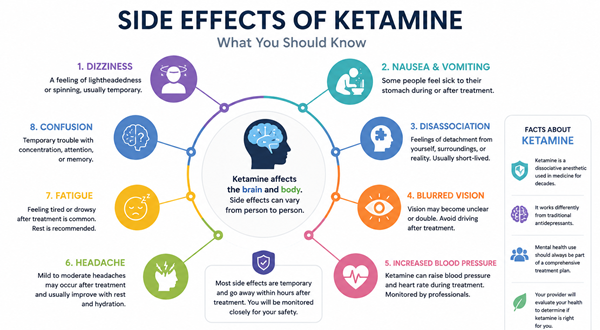
Some common side effects are:
- Dizziness
- Nausea
- Blurred vision
- Sleepiness
- Increased blood pressure
- The student is not connected to the environment.Student is not in touch with the environment.
- Some level of anxiety during treatment.
- Headache
These symptoms will improve within a few days of the treatment.
Ketamine has an impact on perception and coordination, so patients are not allowed to drive after treatment.
Your provider’s attention to your vital signs at each session improves safety.
Need Expert Psychiatric Care in Orlando?
If you are considering taking a break from depression or other mental healthcare difficulties with the aid of Ketamine, the skilled team at Orlando Premier Psychiatry can help. We provide in-depth psychiatric assessments, individualized medication management and understanding care tailored to your needs.
Contact us for a consultation today to find out if ketamine therapy or another scientifically-proven treatment is the best option for you.
(407) 565-3546
Who May Benefit From Ketamine Therapy?
Not everyone can benefit from Ketamine Therapy.
Psychiatric evaluation conducted to determine if there’s any benefit.
There are people who are potential candidates such as those with:
- Treatment-resistant depression
- Severe depression
- Suicidal ideations that are persistent and warrant immediate psychiatric evaluation.
- Certain anxiety disorders
- PTSD
- Counseling regarding bipolar depression (with proper selection)
Failure to respond to multiple antidepressant medications. Failure to improve with multiple antidepressant medications.
People who have uncontrolled blood pressure, a history of current drug abuse and/or psychiatric disorders may require alternative treatment.
Always the first step is a detailed evaluation.
When to Speak With a Mental Health Professional
If you have any of the following symptoms, it may be a good idea to consult a mental health therapist:
- Persistent sadness for more than 2 weeks
- Feelings of boredom with things you used to like doing
- Constant anxiety
- Trouble in performing tasks at work or school
- Altered sleep and/or eating patterns.
- Feelings of hopelessness
- Suicidal thoughts or thoughts of harming oneself.
Low mood that lasts for longer than 14 days.
One of the first symptoms of dementia is loss of interest.Loss of interest in activities they previously enjoyed are sign of dementia.
- Constant anxiety
- Problems working or going to school
- Changes in sleeping or eating habits.
- Feelings of hopelessness
- Thinking about hurting oneself or suicide
- Early intervention can be beneficial.
The psychiatric providers from Orlando Premier Psychiatry design treatment plans that are based on the individual’s symptoms, medical history and treatment goals.
Take the Next Step Toward Better Mental Health
When a person’s life is still negatively impacted by depression or a related mental health disorder, it is not something they need to handle on their own. At Orlando Premier Psychiatry, we provide compassionate psychiatric evaluations, medication management and individual care plans customized to meet your needs.
Call Orlando Premier Psychiatry today to find out if ketamine or other medicine-based psychiatric treatment options are right for you.
Frequently Asked Questions
What type of drug is ketamine?
Ketamine is a dissociative anesthetic drug that has been used for decades in medicine in a safe way. It is also employed in psychiatric settings as it can help to quickly alleviate the symptoms of depression in patients who have been carefully selected and monitored by a healthcare professional.
Is ketamine a dissociative anesthetic?
Yes. Ketamine is a dissociative anesthetic drug. Short-term alteration of perception, awareness and pain processing, retaining many protective reflexes, useful for anesthesia and some psychiatric applications.
How does ketamine work in the brain?
Ketamine is a primary inhibitor of NMDA receptors that mediate glutamate signaling. This action may help to form new neural connections and, in some cases, enhance the transmission of signals between brain cells, which can lead to a quicker improvement in mood than many other antidepressant drugs.
What is ketamine used for?
Ketamine is an anesthetic, used to treat pain, emergency and psychiatric conditions such as treatment-resistant depression. Use of mental health services should, at all times, be part of a complete care plan and under the qualified medical supervision of a health professional.
Is ketamine approved for treating depression?
While ketamine is off-label and widely used by qualified therapist for depression, itself it is not FDA approved specifically for depression. A similar drug, esketamine nasal spray, is FDA approved for treating treatment-resistant depression under certain conditions.
What is the difference between ketamine and esketamine?
Ketamine is composed of two mirror-image molecules, esketamine is composed of one of the two molecules (the S-enantiomer). Esketamine is an FDA-approved nasal spray for adults with treatment-resistant depression, and is taken through a Risk Evaluation and Mitigation Strategy (REMS) program.
Is ketamine considered a narcotic or opioid?
No. Ketamine is not a narcotic or an opioid. It is a dissociative anesthetic and acts on receptors in the brain that are distinct from opioid pain drugs.
Disclaimer
This article is intended for educational purposes only and should not replace professional medical advice, diagnosis, or treatment. Always consult a qualified psychiatrist or healthcare provider before starting, stopping, or changing any medication or mental health treatment. If you are experiencing a mental health emergency or thoughts of self-harm, seek immediate emergency assistance or contact your local emergency services.
References
- National Institute of Mental Health (NIMH). Ketamine and Mental Health Research. https://www.nimh.nih.gov
- U.S. Food and Drug Administration (FDA). Spravato (Esketamine) Information. https://www.fda.gov
- National Institute on Drug Abuse (NIDA). Ketamine DrugFacts. https://nida.nih.gov
- American Psychiatric Association (APA). Practice Guidance on Depression and Emerging Treatments. https://www.psychiatry.org
- Mayo Clinic. Ketamine for Depression: What to Know. https://www.mayoclinic.org